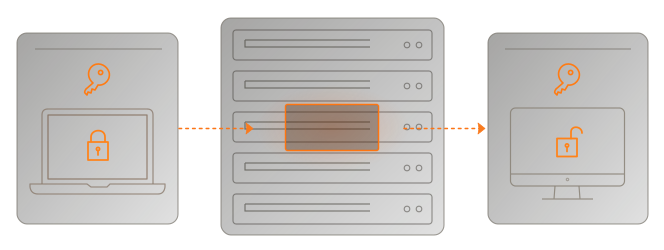
Client device
Encrypts sensitive data before it reaches the network.
POST-QUANTUM END-TO-END ENCRYPTION
Most cybersecurity is built to stop attackers getting in. Clave protects sensitive data after they do, by encrypting it on client devices, to enterprise access policies, before servers or databases ever see it.
Encrypts sensitive data before it reaches the network.
Stores and moves ciphertext without being able to read it.
Decrypts only the information its user is allowed to access.
THE STRUCTURAL PROBLEM
Organisations limit what each person can access, but the servers and databases between them still see the whole dataset. Encryption at rest protects a disk, while encryption in transit protects a connection. Neither protects data from the server that decrypts it.
When that server is compromised, the attacker gets everything in one fell swoop.
When an attacker compromises central servers or key management systems, they get everything.
Central infrastructure handles only ciphertext, with keys dynamically reconstructed on edge devices. Total compromise reveals nothing.
HOW CLAVE WORKS
Signal and WhatsApp encrypt messages on one person's device and decrypt them on another. The service in the middle never has the keys, so breaching it doesn't reveal the conversation.
Doing this at enterprise scale has been out of reach for years because access changes constantly across many users and resources. Clave's unique technology encrypts data directly to those access policies on client devices, making it practical to secure data in large-scale systems, even against server compromise.
THE URGENCY
AI systems are becoming capable of finding and exploiting vulnerabilities with less and less human involvement. At the same time, that capability is moving from a small number of frontier laboratories towards models that can be run and adapted far more widely.
Modern AI is accelerating offensive cyber faster than defenders can keep up. As open-weight models catch up to Mythos-level capability, small-scale attackers will be able to construct sophisticated attacks once only available to nation-states.
Anthropic's Mythos demonstrated near-autonomous vulnerability discovery and exploitation across browser sandboxes, the Linux kernel, and thousands of open-source projects in April 2026.
Z.ai's recently released GLM-5.3 shows advanced cyber capability moving into open-weight models. The defender's window is narrowing rapidly.
WHAT CLAVE PROTECTS
Clave protects data without taking it out of use. An organisation can begin with the information whose exposure or manipulation would cause the greatest harm.
Protect sensitive documents and high-value records throughout storage, transfer and authorised access.
Encrypt individual fields or sections inside documents, images, and data feeds.
Protect sensor, media, and operational data continuously while authorised systems keep using it.
TALK TO CLAVE
Tell us your worst-case scenario: what would happen if an attacker broke into your central infrastructure today? We can make that not matter.